
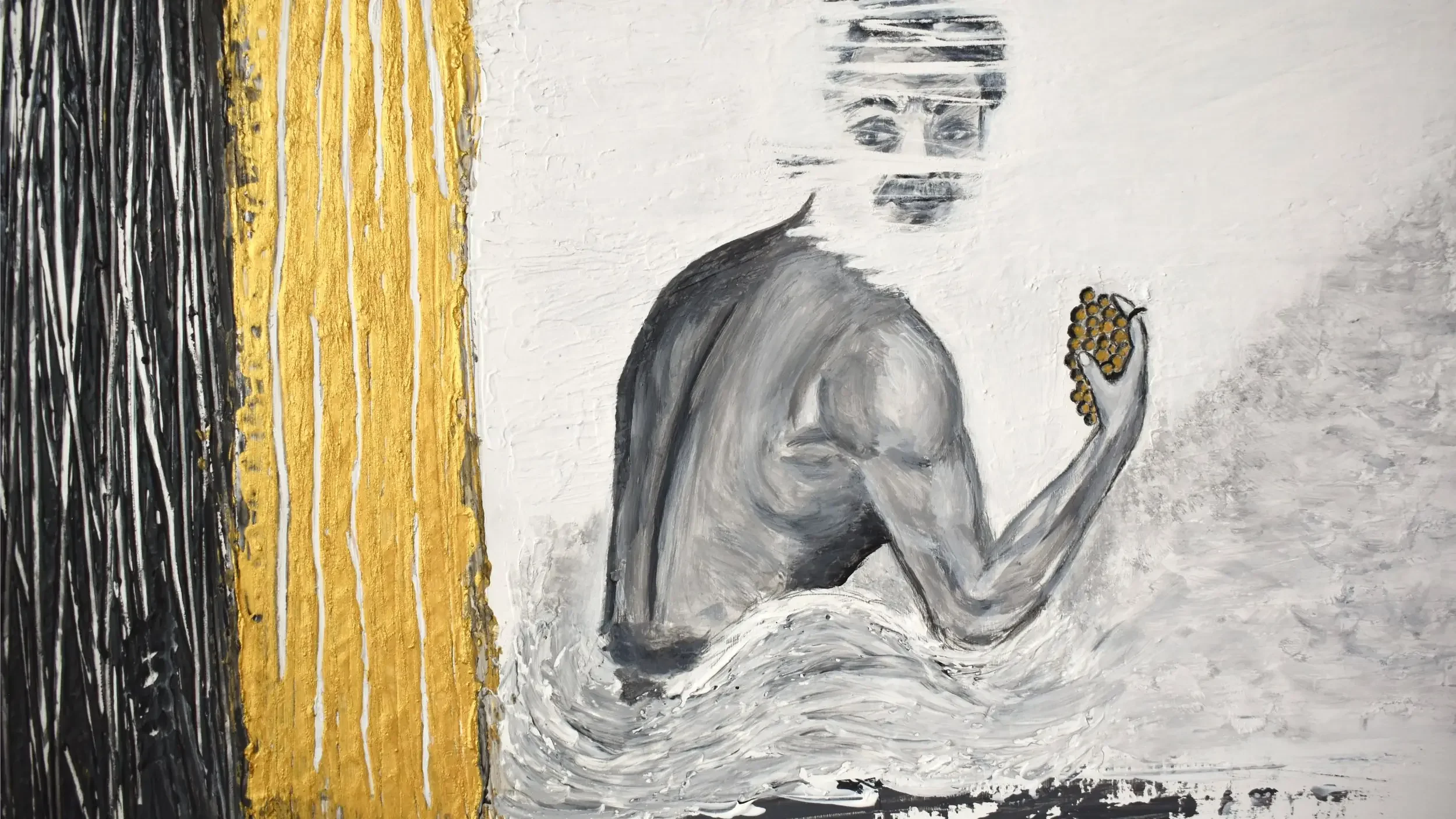
Bacco
Where do we find peace?
An Intimate Journey into Memory
A Path Through Loss
In this profound and personal interpretation, Francesca V Kranz moves away from the traditional iconography of the god of wine to embark on an intimate journey into memory and mourning. Dedicated to the figure of her late father, the painting transforms the myth into a reflection on passing time and the acceptance of loss. The title itself, Where do we find peace?, is not a rhetorical question, but the opening of a search for meaning—a query that finds its answer within the very matter of the work.
The Golden Pillar of Heritage
The subject is isolated and immersed in an indefinite space, almost imprisoned in an atemporal dimension; yet, this isolation is not despair, but a place of quiet recollection. The textured art technique gives physicality to the background: the golden pillar on the left, tactile and shimmering, represents the solidity, importance, and heritage of the father—a steadfast point that resists the erosion of time.
The Dissolving Portrait
The central figure, portrayed in grey monochrome from the back and in half-bust, emerges from a textured, rippling black abyss, symbolizing death and the unknown. This emergence from the dark suggests that memory is not static, but an act of will that allows us to reclaim what once was. The face, covered by a thick white and chalky layer that blurs its features, serves as the most powerful visual metaphor of the work: the father's memory is dissolving, no longer sharp, but transforming into an essence—a presence that recedes to leave room for pure memory.
The Luminous Cluster: Memory and Vitality
The emotional core of the work, however, resides in the luminous cluster of grapes held tightly in his hand. This element, crafted from the same precious matter as the pillar, stands as the antithesis of the face's dissolution. It represents the life, energy, joy, and love for existence that the father embodied and that continues to live on within the memory. The hand supporting it is a gesture of affirmation, an attempt to hold onto the essence of life despite the awareness of loss.
The Cathartic Resolution
The choice of the interrogative Where do we find peace? constitutes a masterful narrative evolution to close the triptych alongside Narciso and Giuditta e Oloferne, transforming the series from an analysis of malaise into a quest for resolution. The "Bacco" dedicated to the father becomes the focal point where the tension of the preceding works finally finds stillness. Peace is not found in the impossible attempt to stop time or to keep the image of the departed intact; rather, the work suggests that inner peace resides in accepting dissolution, in the capacity to let go of form to embrace memory. Bacco is no longer the god of excess, but a father who, while fading, hands down his most precious gift: vitality, represented by the golden grape cluster.
A Circular Legacy
In this sense, the triptych completes itself as a circular path and a powerful dialogue among the works:
Narciso – What fills the void?: This question poses the problem of the constant search for fulfillment within the performative and inner emptiness of a world that demands perfection—a void that cannot be filled by an exterior image.
Giuditta e Oloferne – Who is the victim?: This question shifts the conflict outward, analyzing duality, violence, and the loss of innocence within the dynamics of power and identity in an attempt to change history.
Bacco – Where do we find peace?: This question offers a cathartic closure. The tension and emptiness of the previous paintings find rest in a memory that, though fading, becomes a lifeline. Peace is not a static condition, but a process of reconciliation with one's fragilities, with time, and with memory, allowing us to honor those we have loved by transforming grief into a form of love that resists oblivion. It is a positive imprint, a loving embrace with one's own history and pain, transformed into a luminous pillar and a cluster of grapes: memory and life entwining forever.
Ultimately, the triptych ceases to be merely a series of existential questions and becomes a true journey: from the fragmentation of the self (Narciso), to the conflict with the other (Giuditta e Oloferne), all the way to the reconciliation with memory and time (Bacco).