
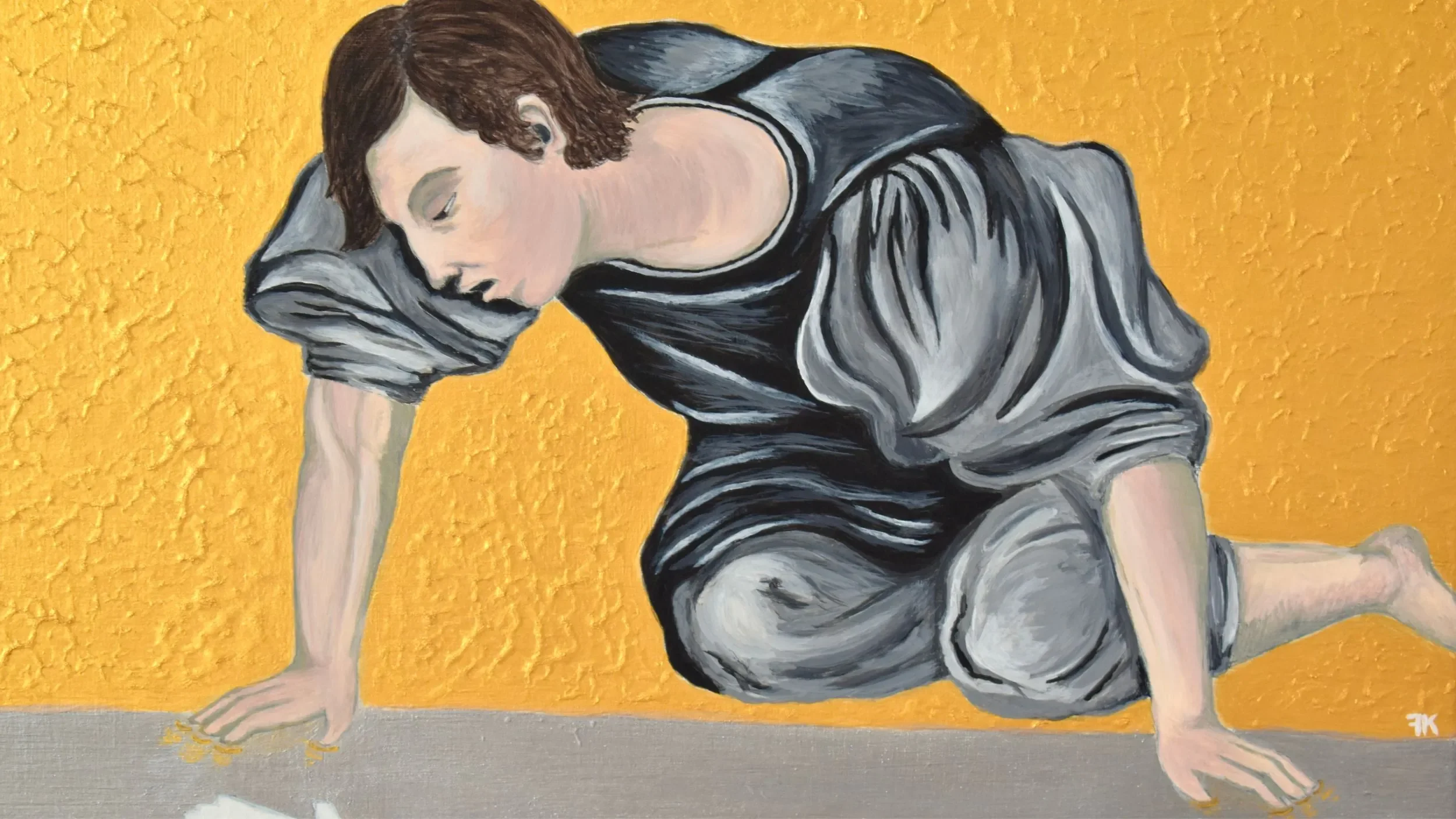
Narciso
What fills the void?
The Philosophical Nexus
The Shape of Absence
In the stillness of this canvas, Francesca V Kranz deconstructs the myth of Narcissus, stepping away from the traditional narrative of self-obsession to focus on something far more unsettling: the experience of the void. By moving the focus from the act of self-gazing to the emptiness found within the reflection, the artist turns a tale of vanity into a reflection on our own internal lacks. Here, Narcissus isn't captivated by his own beauty, but is instead confronted by a silence that reveals the frightening truth of what happens when we look too closely at ourselves.
A Dialogue with Caravaggio
The formal reference to the poetics of Caravaggio serves as the lifeblood of this work. If the 17th-century master investigated human psychology through the dramatic contrast of light and shadow, here the confrontation occurs between matter and absence. While the Caravaggesque Narcissus is typically cloaked in darkness, this contemporary reinterpretation isolates the figure within a golden, pulsant space that heightens his solitude. The textured art technique renders the background a tactile, agitated surface; the gold is not ornament, but the very weight of a reality that presses against the protagonist, forcing him to fold inward upon himself.
The Posture of Despair
Narcissus appears here in a moment of collapse. Crouched on the ground, he shows a raw, fragile state. He is wrapped in a heavy, slate-grey garment—a shroud that anchors the figure and creates a sense of quiet unease. His physical tension leaves him defenseless, turning his search into a visceral, human act. His gaze, fixed and intense, shows a man grappling with the difficult realization that the meaning he is looking for remains out of reach.
The Materiality of the Void: An Impossible Fusion
The dramatic core of the work resides in the white, lower portion of the canvas: the void. Where tradition has conditioned us to see the reflection of an image in water, the artist here intervenes with a material laceration that transcends the simple concept of self-love. The white mass is not clear water, but a dense, irregular substance, realized with a chalky material that transforms the reflection into an abstract, formless simulacrum. This reflection is the lacerated void we carry within—a surface that attempts to restore an identity but ends up revealing only an open wound, an entity that Narcissus attempts to grasp with a desperation that borders on horror. His fingers approach this white mass with a gesture evoking an impossible fusion; yet, in the exact moment he seeks to touch it, he realizes that the reflection is nothing more than the void.
Performance vs. Depth
The question What fills the void? becomes a powerful metaphor for our current era, defined by the contrast between surface and depth. In a world that demands we be constantly performative, visible, and "perfect"—where social media serves as our contemporary pool of water—this work confronts the desperation born from such imposition. Narcissus is no longer the youth in love with himself, but the symbol of the modern individual, meticulously curating their surface to hide, behind a mask of efficiency, the anguish of an ever-expanding emptiness.
The Courage of Imperfection: A Lasting Warning
The painting questions the nature of our identity: how much of what we show is real, and how much is merely an attempt to fill the void we feel? The lacerated void the artist has imprinted onto the canvas is a symbol of a fragility that can no longer be contained. There is no triumph in Narcissus’s gesture, only a solitude that reverberates in the silence of the canvas. Avoiding explicit melodrama, Kranz challenges the viewer to recognize that, in an age that demands we be impeccable, true authenticity lies in the courage to look into that white space, to accept the void, and to cease seeking confirmation in a reflection that can never fulfill our essence. The myth becomes a contemporary meditation on the suffering of those who struggle to appear in a world that has forgotten how to look within.