
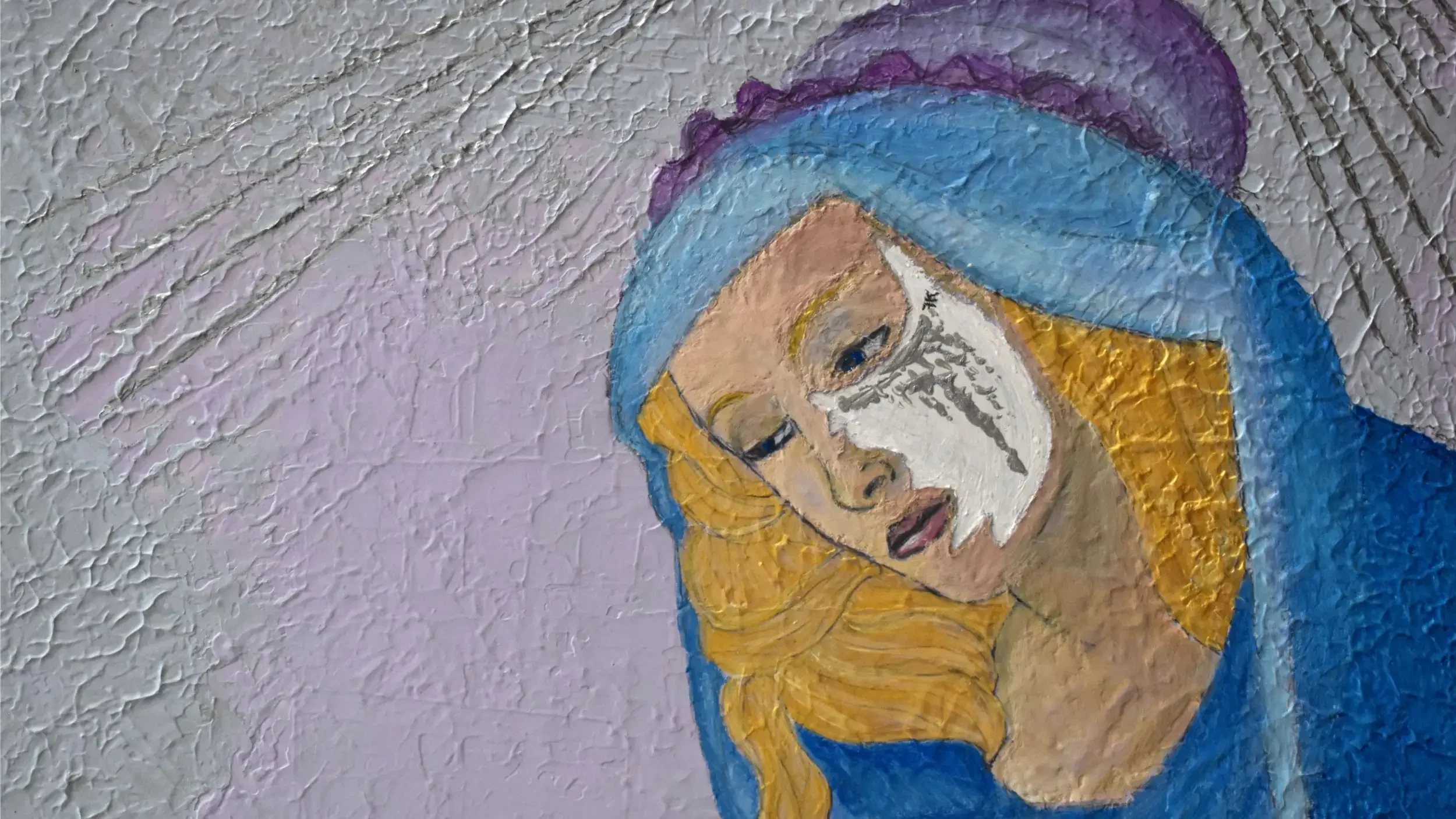
Madonna.
Aura Lacrimarum.
Sacred Humanism
The Anatomy of a Threshold
In this representation of the Madonna, Francesca V Kranz engages with one of the most codified and recognizable iconographies in Western tradition, reimagining it through a sensibility that shifts the focus from devotional representation to emotional interiority. The painting exists in an implicit dialogue with the Italian Renaissance—recalling the formal grace of Botticelli and the compositional equilibrium of Raphael—only to profoundly redefine their underlying meaning.
The Terrestrial Light
In classical tradition, the Virgin is often depicted as an image of perfection and serenity, suspended in an ideal dimension that neutralizes emotional conflict. In Kranz’s work, however, the figure emerges not as a reassuring icon, but as a presence traversed by internal tension. Here, the sacred does not coincide with harmony, but with a complex, deeply human experience.
The background, with a texture reminiscent of frescoed surfaces, introduces a temporal and atmospheric dimension that envelops the figure. A delicate layering of pastel tones creates a suspended space, traversed by a light that emerges from the lower left and ascends across the face. This choice disrupts traditional iconographic conventions: light does not descend from above as a transcendent manifestation; instead, it originates from a more earthly dimension, internal to the pictorial space. In its ascending movement, this light constructs the face, revealing its features and amplifying its emotional presence, suggesting a grounded relationship between the sensible and the sacred.
The Silver Circuit: Radiance and Tears
The conceptual core of the work resides in the relationship between the rays radiating from the head and the tears on the face. The rays reinterpret the iconographic tradition of the halo, transforming it into a dynamic and pervasive force. Far from a mere symbolic attribute, they manifest as a physical presence—a spiritual condition that does not offer refuge but instead completely exposes the subject.
The profound meaning of the work is synthesized in the silver tears. These are not signs of despair or weakness, but of an intense, restrained awareness. The use of silver creates a closed circuit between the external (the radiance of the halo) and the internal (the emotion of the face), linking what is manifested with what is felt.
The Fracture of the Surface
Technically, this tension between surface and depth is rendered through a three-dimensional interruption of the pictorial plane. The silver flow of the tears is deposited where the face itself breaks away, allowing the stark white of the raw canvas to emerge. This "void" serves as a powerful metaphor for the vulnerability inherent in the sacred.
The gaze, slightly lowered, eschews direct contact with the viewer, favoring an introspective, gathered dimension. The figure is turned toward an inner experience rather than an external audience.
A Contemporary Sacredness
Through this vision, Kranz moves away from the traditional image of the Madonna as a vessel of immobile perfection. She proposes instead a figure that exists at the precise contact point between spirituality and lived experience. In this contemporary reading, fragility becomes an integral part of the sacred manifestation—a sanctity that is not distant or abstract, but rooted in the body, the sensitivity, and the quiet endurance of the human condition.