
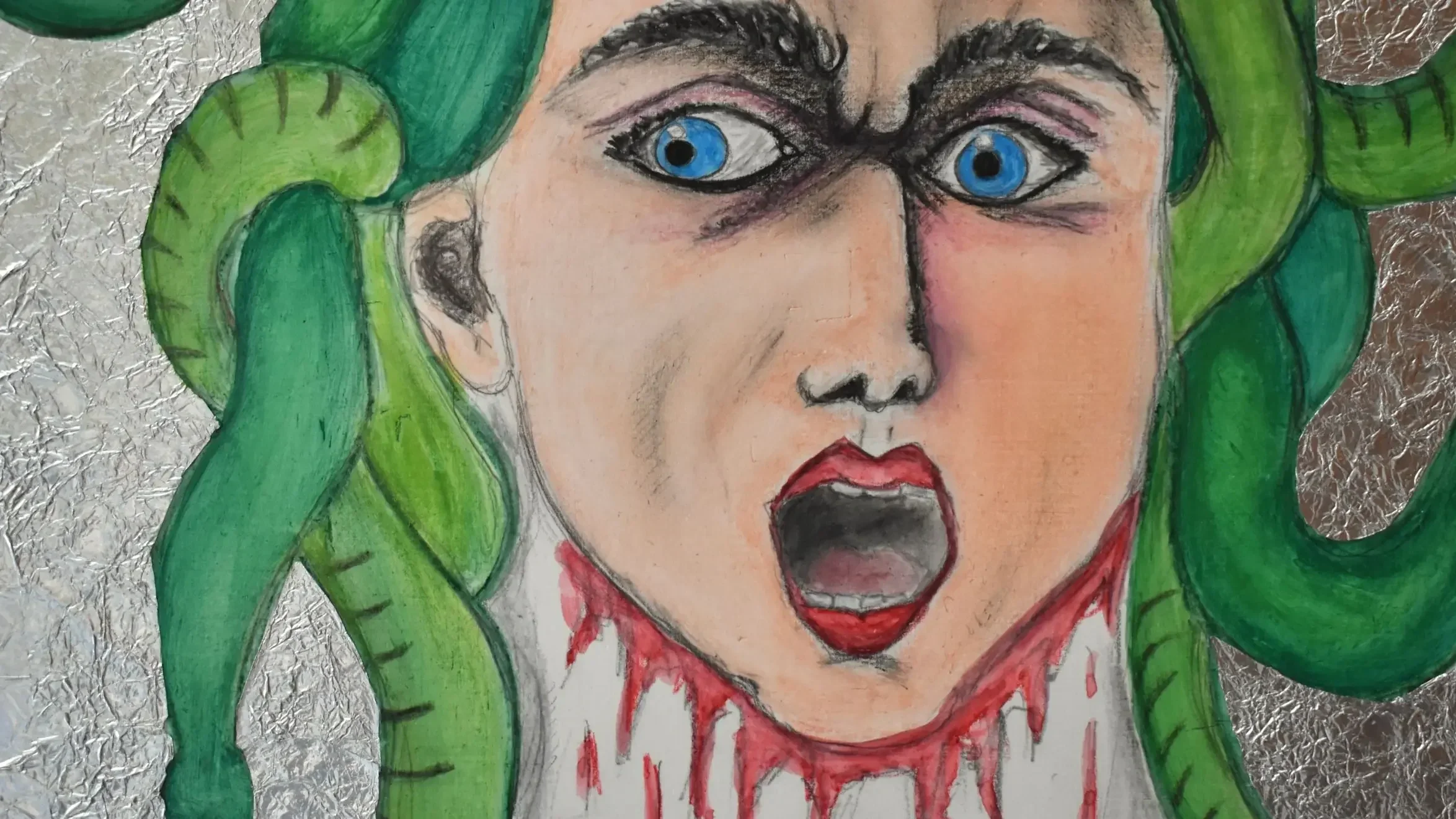
Medusa.
Mirror of reflections.
The Reflective Gaze
Between Myth and Presence
In this interpretation of Medusa, Francesca V Kranz confronts one of the most symbolically charged icons in Western art. In classical mythology, the Gorgon personifies the petrifying power of the gaze—an ambivalence between attraction and terror that has permeated art history, from ancient reliefs to Caravaggio’s arrested moment of violence.
Kranz reimagines this imagery through a shift in perspective, prioritizing the figure’s emotional landscape. The Medusa emerging from the canvas is not merely a mythological creature, but a complex psychological presence.
The Anatomy of the Wound
The face is presented frontally, achieving an almost iconic status that echoes classical monumentality. Within this stability, a fracture emerges: blood cascading down the face, its redness intensified by the stark contrast of the luminous white background below. Here, the blood transcends its narrative role; it becomes a visceral pictorial element that renders the physical and psychological dimension of the wound visible. The surrounding white amplifies this tension, transforming the canvas into a quasi-surgical space where the mark of the trauma is isolated and inevitably central.
The Aluminum Ground: A Conceptual Mirror
A defining characteristic of the work is its reflective background, crafted from a manipulated aluminum surface. By compressing and then distending the material, the artist creates a rippled, irregular texture that captures and reflects light in a state of perpetual flux. This metallic surface functions as a contemporary surrogate for the mirror in the myth—the tool that allowed Perseus to confront the Gorgon without being turned to stone.
In Kranz’s work, this element acts as a conceptual device. The reflective surface is not a passive backdrop; it actively interacts with the ambient light and the physical presence of the viewer. As the light shifts, the drama of Medusa is multiplied and redistributed across the space, potentially echoing into infinity.
Participatory Perception
The observer is inextricably drawn into this visual mechanism. Every movement of the viewer’s body and gaze alters the perception of the image. Consequently, the work attains its full existence only in the moment of encounter. The viewers do not merely witness Medusa’s drama; they become part of it, their very presence dictating how light diffuses across the metallic surface and how the face reveals or conceals itself. The image is never static; it is perpetually renewed through the interplay of matter, light, and the "other" gaze.
Technical Innovation: Quartz and Chromatic Vitality
Technically, the work stands out for its unconventional synthesis of materials:
The Ground: A preparation of quartz creates a granular, haptic base that grips and amplifies the pigment.
The Medium: The face is rendered using water-soluble wax pastels. This technique allows the pigment to dissolve and expand with a vibrant fluidity.
The Palette: The interaction between the pigments and the quartz base produces a brilliance that borders on the flamboyant, recalling the chromatic vitality of Pop Art.
This contrast between a subject heavy with iconographic memory and an intense, contemporary palette creates a jarring, sophisticated visual tension.
Tragic Strength and Motion
The traditional mass of snakes—the most monstrous attribute of the Gorgon—is reinterpreted as a field of energy. While the face remains stable and frontal, the hair generates a system of lines and forms that introduce instability and motion.
The emotion emanating from the canvas is not one of pure terror. Medusa’s gaze is not aggressive; rather, it conveys a silent awareness of her own condition. She is a tragic figure, marked by an irreversible transformation yet endowed with an immobile strength. Through this lens, the artist transforms the myth into a metaphor for a gaze that reflects upon itself—a threshold where the wound, memory, and the act of looking converge.