
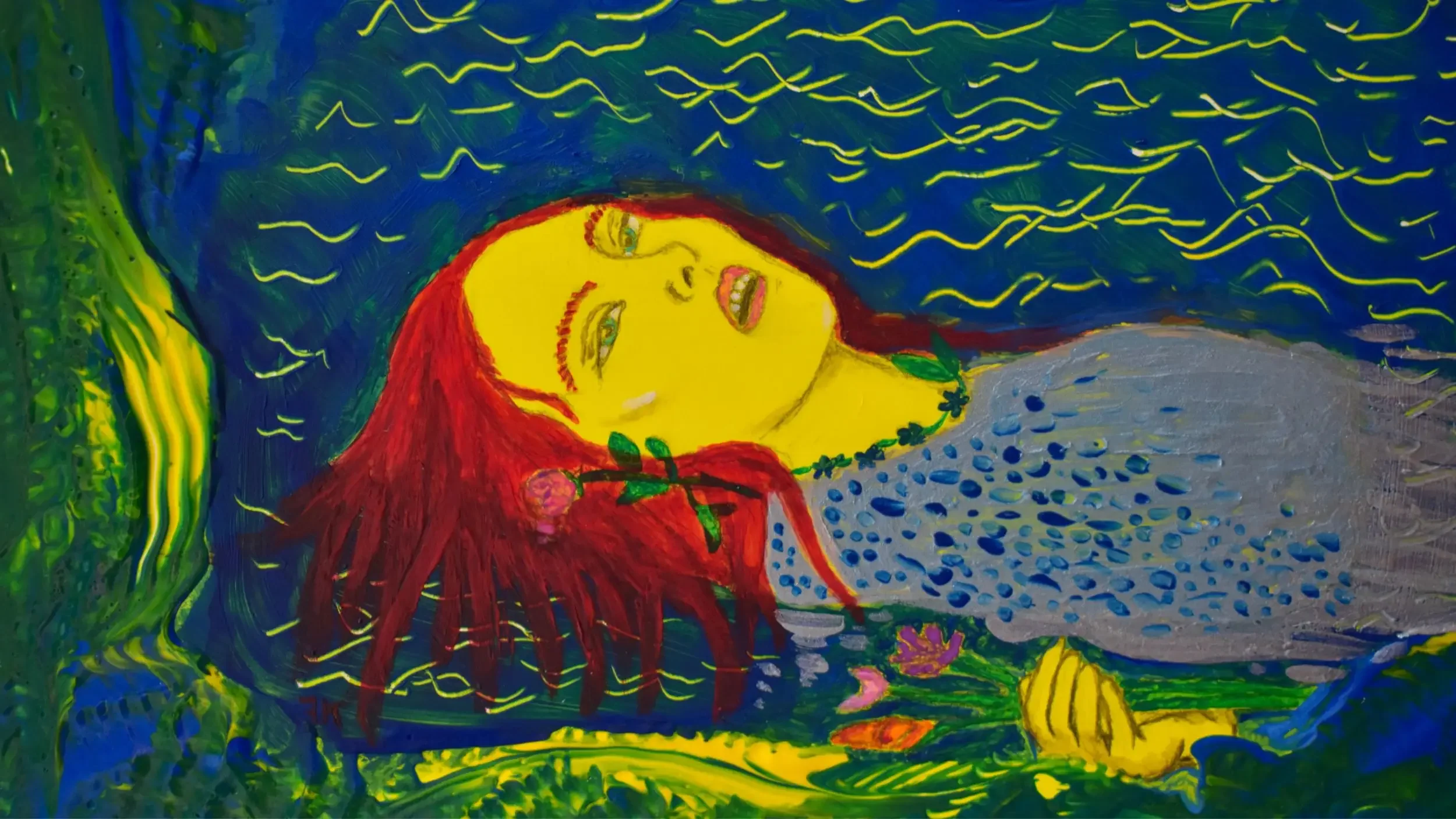
Ofelia.
Back to Nature.
The Poetics of Dissolution
An Inquiry into the Fluidity of Form and Spirit
In this interpretation of Ophelia, Francesca V Kranz engages with one of the most densely layered icons of art history—a Shakespearean figure perpetually suspended between innocence, abandonment, and dissolution. The weight of pictorial tradition, most notably the iconic vision of John Everett Millais, is here absorbed and transmuted into a more intimate exploration, centered on the emotional dimension of the face and the symbiotic relationship between figure and landscape. Nature is no longer merely the stage for the protagonist’s demise; it becomes a pictorial substance that progressively fuses with the subject.
The Threshold of Identity
The composition is built upon a calibrated balance between classical figuration and a suspended atmosphere. The face emerges with delicacy, modeled by soft chromatic transitions and a diffused light, while the hair expands into the space as a living matter, gradually dissolving into the vegetation. This continuity between body and nature is central to the work’s economy: the figure does not simply appear immersed in the environment but is progressively absorbed by it, as if the boundary between identity and landscape were slowly evaporating.
The Vegetal Frame: A Visual Device
A primary conceptual element is the vegetal frame that envelops the composition. Far from being a mere decorative motif, this pictorial structure functions as a visual device that guides the gaze and redefines the relationship between the observer and the image. The vegetation generates an organic continuity; branches and leaves draw closer to the face, creating a visual threshold that leads the eye toward the work’s emotional core.
Simultaneously, this frame acts as an opening within the pictorial space. The effect is that of looking into the canvas, as if the surface were a window providing access to a private, gathered realm. The vegetation thus becomes a permeable margin: it delimits the image while paradoxically accentuating its depth. The subject surfaces from this natural entanglement with a silent but intense presence, appearing as if emerging from an interior landscape.
The Grammar of Primaries
The visual architecture of the work is governed by a precise chromatic system based on the dialogue between the three primary colors: yellow, red, and blue. This choice introduces an essential grammar of painting, suggesting a fundamental origin from which the entire image is generated.
Yellow: Dominating the face and hand, yellow assumes a symbolic function. It is not a realistic flesh tone but an interior luminosity, imparting an ethereal quality to the figure. It represents fragility and emotional vulnerability, yet also the life still pulsing beneath the surface.
Red: Appearing as an emotional intensification, red finds its expression in the hair. Its fluid, enveloping movement introduces a dynamism that contrasts with the stillness of the face. It reveals the vital energy of the figure, following the invisible flow of water and flora.
Blue: Acting as the color of depth and stillness, blue stabilizes the composition and introduces a contemplative dimension, generating the characteristic sense of silence and suspension.
Technical Mastery and Internal Light
The green of the vegetal frame is achieved through a deliberate process: blue is layered over a yellow base, creating a spectrum of greens that retain the luminous vibration of the underlying yellow. This technique produces a flora that is not opaque or heavy, but traversed by light—as if illuminated from within. Consequently, the yellow of the skin continues to live beneath the surface of the leaves, establishing a visceral link between the body and its surroundings.
Technically, Kranz works on the transitions between material density and chromatic fading. The vegetation possesses a thicker stratification, with brushstrokes that build texture and movement, while the face is treated with a smoother, more radiant finish. This contrast reinforces the figure’s state of fragile suspension.
A Contemporary Metamorphosis
The emotion within the painting does not rely on dramatic gestures. Its power resides in a quiet intensity—a profound silence. The viewer does not witness an explicit tragedy but a moment of poetic dissolution. In this vision, the artist transforms the traditional iconography of Ophelia into a deeply contemporary image: no longer just a Romantic symbol of fragility, but a fusion of identity and nature—a metaphor for an interior space where memory, image, and perception interweave until they become indistinguishable.