
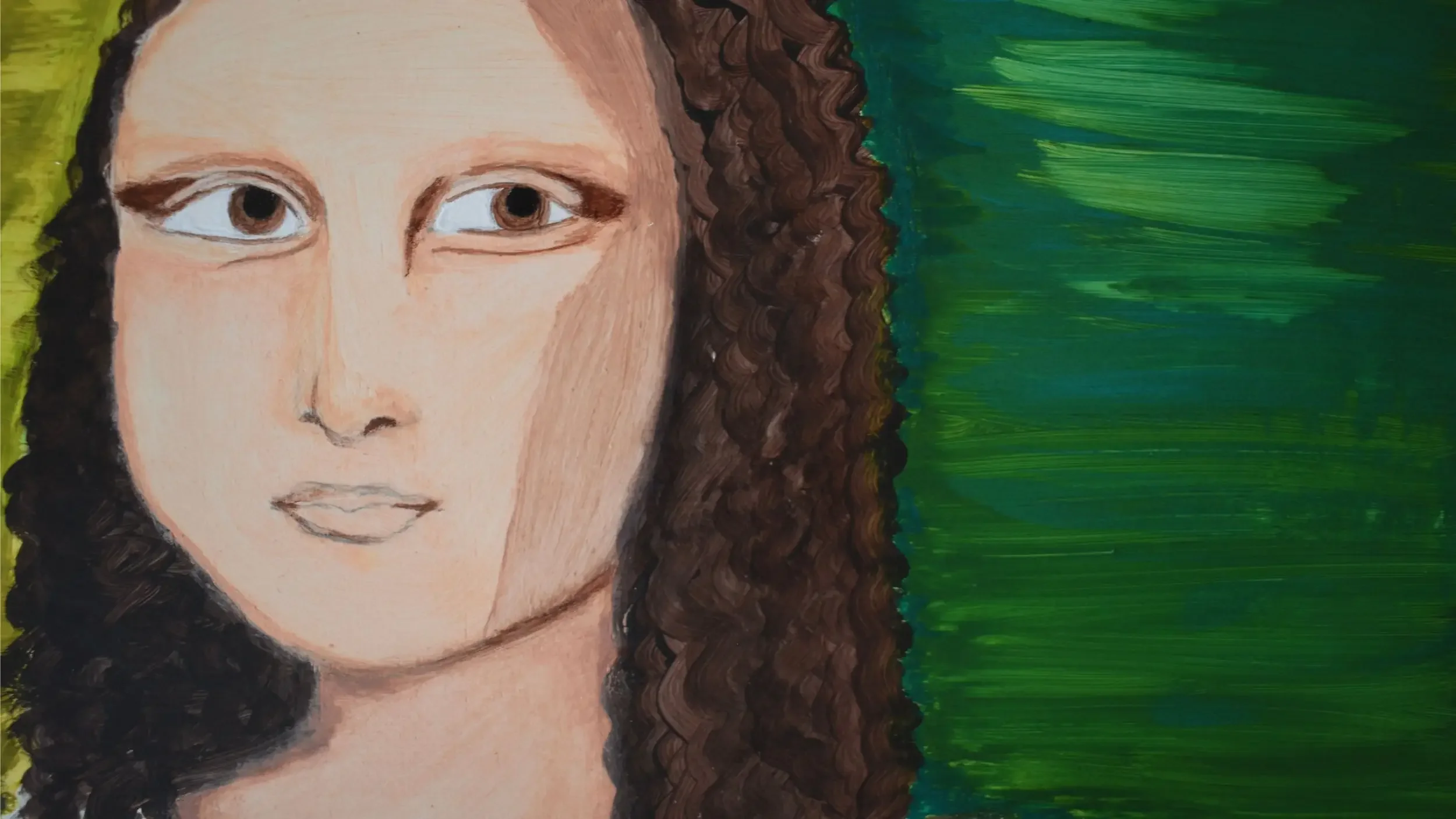
Monna Lisa.
Discomfort zone, stably unstable.
The Illusion of Permanence
Challenging the Immutability of the Classical Canon
In this interpretation of the Mona Lisa, Francesca V Kranz intervenes upon an image that has achieved near-absolute stability within art history, transforming it into an open field of inquiry: to persist in one’s form or to activate a transformation.
The work retains recognizable structural elements—the posture of the torso, the architecture of the gaze, the centrality of the face—while introducing a progressive variation that fractures the very notion of permanence.
Materiality and Tension
The face asserts itself with a sharp, defined presence, possessing a visual quality that suggests a contemporary synthesis akin to Pop Art in its intensity and clarity. This rendering is further heightened by the use of water-soluble wax pastels for the flesh tones, yielding a compact and vibrant luminosity that keeps the color both saturated and rigorously controlled. The solidity of the subject enters into direct tension with a background that rejects definition. Here, the background sheds its function as a continuous spatial construction, evolving into an open surface of layered acrylic brushstrokes. These marks remain visible, traversing the surface and allowing underlying layers to emerge, thereby introducing an ambiguous temporal dimension.
The Dichotomy of Form
The figure and the background do not inhabit the same plane. The face presents itself as a static, delineated presence—held within its own form—while the space behind it appears dynamic and undefined, swept by change. It is within this distance that the core of the work is generated: a stable presence set against an unstable field. The tension is not merely visual but decisional; a question opens without resolving: to remain anchored to what one is, or to initiate a process of self-redefinition.
The omission of the veil amplifies this condition. Nothing filters or shields the face. The figure is presented without mediation, stripped of the element that historically established distance and measure. Here, the face is entirely accessible, yet precisely because of this, it is more exposed to the urgency of taking a position. Identity is not configured as a completed surface, but as a suspended equilibrium between permanence and metamorphosis.
The Gaze and the Observer
The gaze assumes a pivotal role, appearing to hold the possibility of change without fully enacting it, as if the expression were on the verge of shifting. It is a gaze that directly implicates the observer, capturing attention and activating an interrogative dimension. It offers no answers; instead, it perpetually reflects back to the viewer the necessity of choice.
The pictorial surface, unstable and stratified, invites divergent readings:
As a repository of the past: A trace of what has been, an accumulation of experience, and memory persisting beneath the surface.
As a projection of the future: An undetermined space of becoming and a field of transformation.
The Architecture of the Installation
Color becomes the site of tension—intensifying in certain areas and receding in others—rendering perception unstable and precluding a singular interpretation. This tension extends beyond the primary canvas through two additional elements: a monochrome canvas placed above and another below, both framed in precious hues. These seemingly void surfaces act as projection fields. They contain no image, yet they demand one.
The central canvas thus becomes the locus of the present, a space of suspension where the fundamental question is made visible: which direction to take? The work does not propose a solution; rather, it constructs the conditions for each viewer to recognize their own. In this sense, the initial stability of the icon is transmuted into perceptual and conceptual instability: what seemed fixed is revealed as open, and what appeared defined becomes a threshold.